
Reading time: 6 minutes
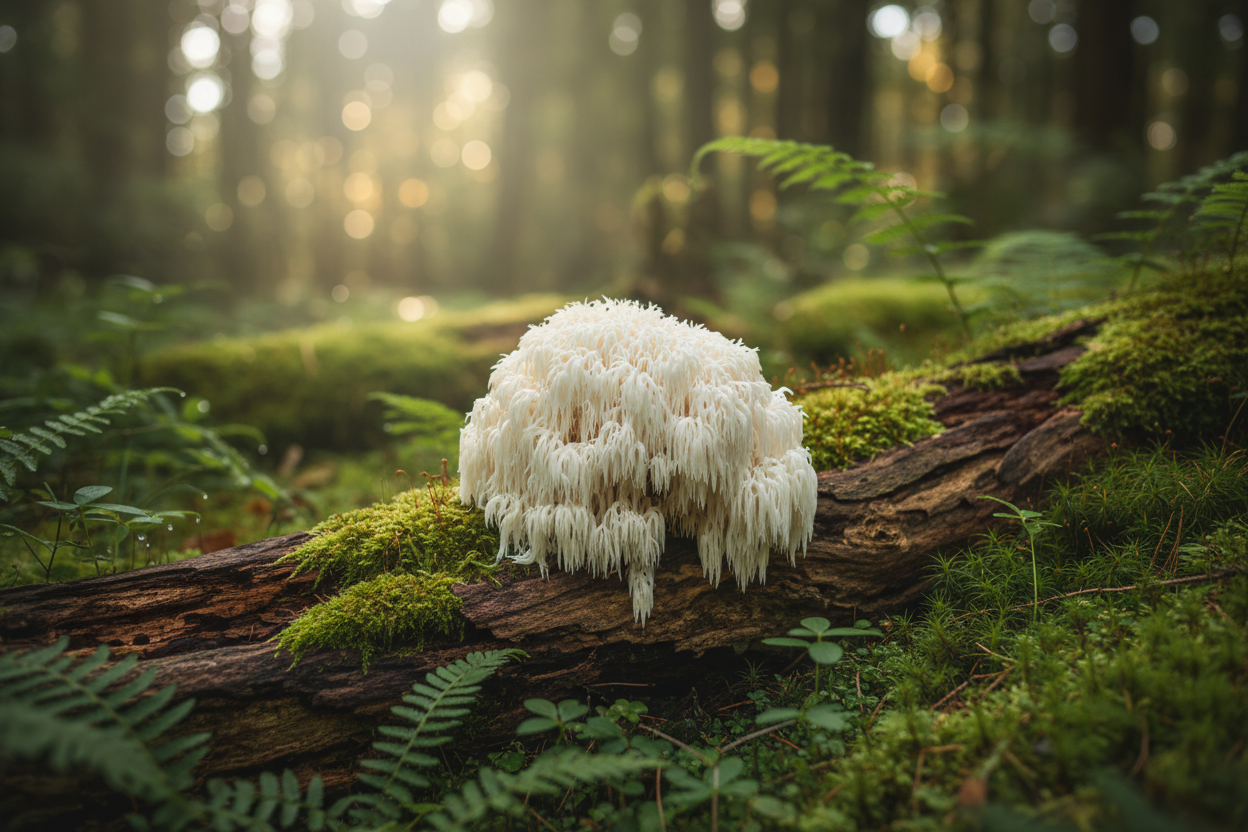
If you've spent any time researching functional mushrooms, you've met Lion's Mane. It's the one that gets people curious — partly because of how it looks (like a white, cascading waterfall growing off the side of a tree), and partly because of what researchers have been investigating in laboratories for the past three decades.
Here's what the science actually says, what it doesn't, and why the form of Lion's Mane you take matters more than most brands will tell you.
What is Lion's Mane?
Lion's Mane (Hericium erinaceus) is an edible mushroom with a long history in traditional Chinese and Japanese herbal practice. In Japan it's known as yamabushitake, named after the mountain-dwelling monks whose robes it was said to resemble. Unlike the tough, woody texture of some medicinal mushrooms, Lion's Mane is genuinely edible — it's often described as tasting like crab or lobster.
But the reason it has captured scientific interest isn't culinary. It's chemical.
The compounds researchers are actually studying
Lion's Mane contains two families of bioactive compounds that occur almost nowhere else in nature: hericenones and erinacines.
This distinction matters, and here's the part most supplement companies gloss over: hericenones are found in the fruiting body — the actual mushroom, the part you'd recognise. Erinacines are found in the mycelium — the root-like network. They are different compounds, found in different parts of the organism.
Both have been studied for the same reason: in laboratory settings, they've been shown to stimulate the synthesis of nerve growth factor (NGF), a protein involved in the growth, maintenance, and survival of nerve cells. Some of these compounds are small enough that researchers believe they may cross the blood-brain barrier — which is what made them interesting to neuroscientists in the first place.
What the research shows — and what it doesn't
Let's be honest about the state of the evidence, because that honesty is the whole point.
Most of the exciting findings come from preclinical studies — cell cultures and animal models. In these settings, Lion's Mane compounds have shown effects on NGF synthesis, neuroplasticity, and markers associated with cognitive function. A widely-cited 2009 Japanese trial explored its effects on mild cognitive impairment, and more recent placebo-controlled work has looked at acute effects on cognition and mood in healthy adults.
But the human research is still early and mixed. Clinical trials have generally been small and short. Some show measurable effects; others don't. Reputable research bodies are clear that the promising preclinical findings have not yet been consistently confirmed in large-scale human trials.
So what does that mean for you? It means Lion's Mane is one of the most genuinely interesting mushrooms in the functional category — with real, identifiable bioactive compounds and a serious research pipeline — but it is not a miracle, and anyone who tells you it's clinically proven to make you smarter is selling you something.
We'd rather show you the research and let you decide.
Why the fruiting body matters
Here's where it gets practical.
Remember that hericenones live in the fruiting body and erinacines in the mycelium? A lot of mushroom supplements on the market are made from mycelium grown on grain — oats or rice — which is then ground up, grain and all, and packed into capsules or gummies. It's cheaper to produce. But it means a significant portion of what you're paying for can be leftover starch from the growing substrate, not mushroom.
You can actually see this in a lab test. Real fruiting body extract is high in beta-glucans — the polysaccharides that define mushroom quality — and low in alpha-glucans (starch). Grain-grown mycelium products tend to show the reverse.
This is why THRILL+ uses fruiting body only for Lion's Mane, at a 10:1 extract ratio. Not because it's cheaper — it isn't — but because if you're going to include Lion's Mane at all, the fruiting body is the part with the hericenones, and the part backed by a verifiable beta-glucan number.
The bottom line
Lion's Mane is a fascinating mushroom with a real research story — one that's still being written. We include it in THRILL+ because we think it deserves its place in a serious functional blend, and because we're willing to be specific about what form we use, how concentrated it is, and what's actually in it.
That's the difference. Not louder claims. Just a clearer label.

Deja un comentario
Este sitio está protegido por hCaptcha y se aplican la Política de privacidad de hCaptcha y los Términos del servicio.